


Cold Header Tooling
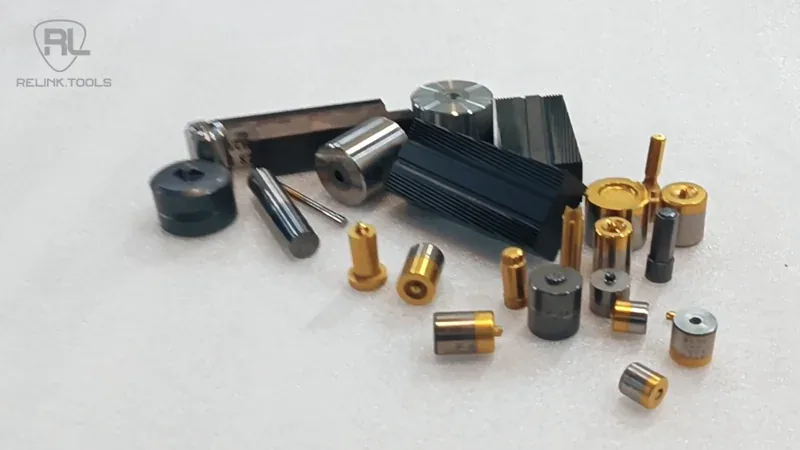
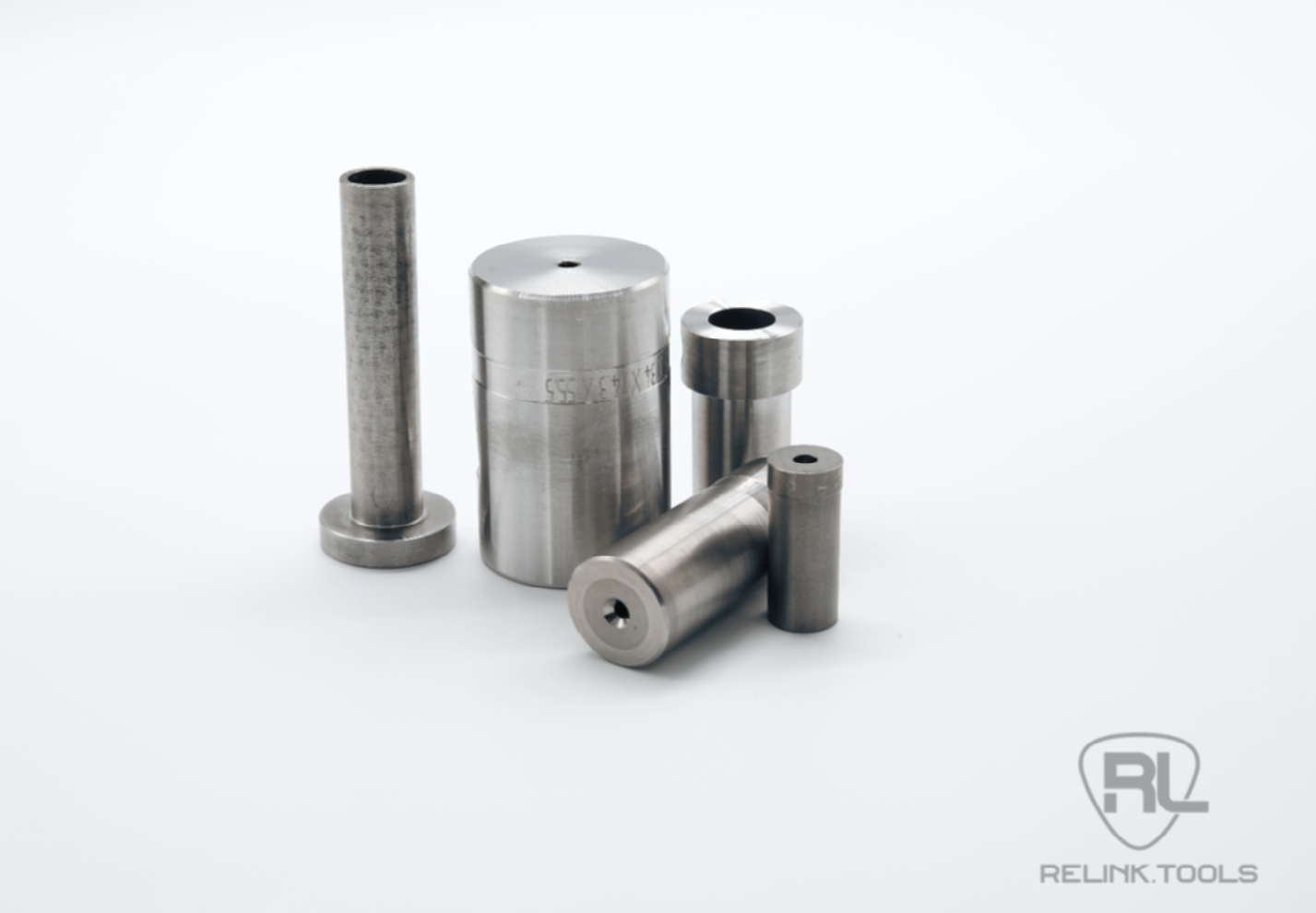
Relink.Tools supplies cold header tooling for construction, general industrial and hardware fasteners: carbide heading dies, punches, carbide-insert tooling in steel cases and bolt trimming dies, made to your drawing or to a worn sample, with a full dimensional inspection report on every order.
| Cobalt (binder) content | About 15–25 % |
|---|---|
| Tungsten carbide content | About 75–85 % |
| Grain size | About 2–9 µm |
| Density | About 13.1–14.0 g/cm³ |
Category: Fastener Tooling
Cold header tooling is the set of punches, dies and trimming dies that a cold heading machine uses to form bolt and screw heads from wire at room temperature. The machine cuts a blank from coiled wire, holds it in the die, and a punch strikes the end one or more times to upset the head; a knockout pin then ejects the part. The tooling takes the full forming load on every stroke, so it is a wear part.
Overview
Overview
Where the tooling sits in the fastener line
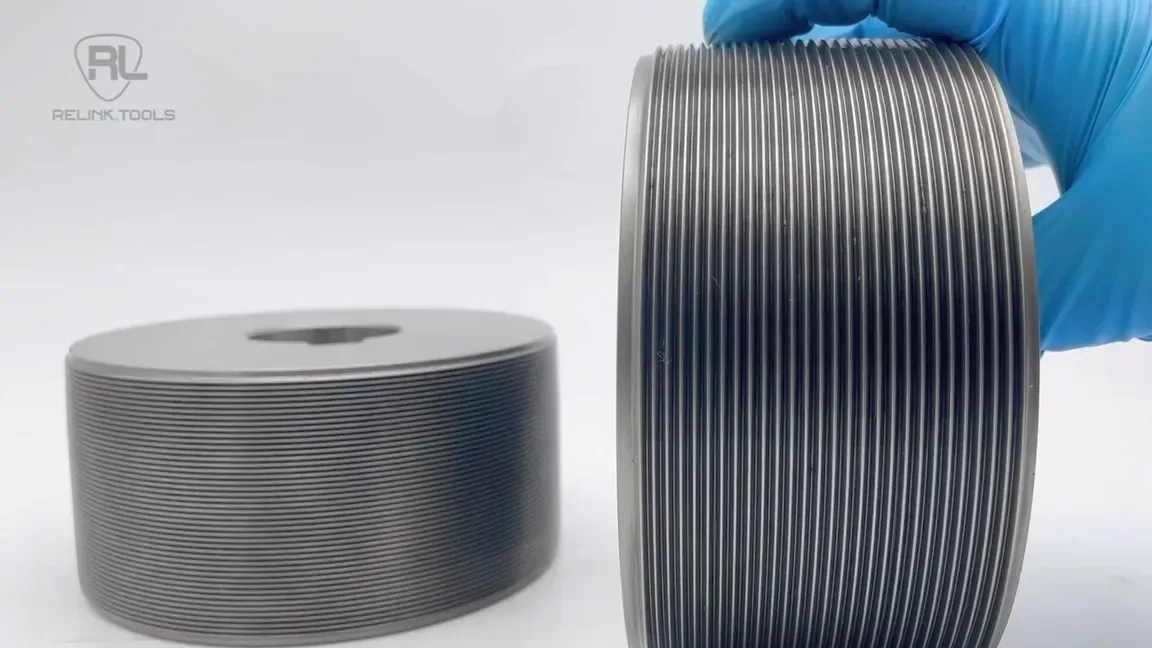
Wire rod is drawn down to the shank diameter through wire drawing dies, cut to length and cold-headed. The headed blank then goes to the thread roller, where thread rolling dies form the thread. Heading dies and thread rolling dies are consecutive stages on the same line, and we supply both.
What we supply
- Heading dies — a tungsten carbide insert pressed or shrink-fitted into a steel case, so the case holds the carbide in compression and takes the impact. Supplied as complete dies or as replacement inserts.
- Punches — first and second heading punches for the common head forms; carbide or tool steel, to your drawing.
- Trimming dies — see below.
- Knockout pins and extrusion dies — on request, to drawing.
Our recommendation: send the part drawing, the wire material and the machine model. From those three we can quote the full die set for the part, not just one piece.
Bolt Trimming Dies
Bolt Trimming Dies
A bolt trimming die trims the round, upset head of a cold-headed blank into a hexagon or square. On a cold header this is the station after heading: the blank is pushed through the trimming die and the surplus metal is sheared off as a thin ring, leaving the finished hex head. (This is the fastener trimming die, not the ammunition-reloading tool of the same name.)
Relink.Tools supplies hex and square trimming dies in carbide-insert or tool-steel construction, for the common bolt sizes. Tell us the across-flats size, the head height and the machine model, or send the drawing.
Specifications
Carbide for cold heading
Cold heading carbide is chosen for toughness first: the die must survive repeated impact, not just abrasion. The grades we supply sit in the ranges below; which end of the range depends on the part.
| Property | Range supplied |
|---|---|
| Cobalt (binder) content | About 15–25 % |
| Tungsten carbide content | About 75–85 % |
| Grain size | About 2–9 µm |
| Density | About 13.1–14.0 g/cm³ |
| Hardness | About 81–86 HRA |
| Transverse rupture strength | About 2,000–2,900 MPa |
The work the die does sets the direction. Where wear dominates — extrusion and reducing — a lower-cobalt grade holds its size longer. Where impact dominates — upsetting and heavy heading blows — a higher-cobalt grade resists cracking.
Our recommendation:
- Heavy impact — large heads, long upsets, hard wire: higher cobalt (around 20–25 %) with a coarser grain. Tougher, less likely to crack.
- Wear-critical dies and stainless steel wire: lower cobalt (around 15–18 %) with a finer grain. Harder, longer wear life where impact is moderate.
- Standard carbon-steel screws and bolts: a mid-range grade with about 20 % cobalt is the usual choice.
Grade is matched to your part, wire and machine, and confirmed on the quotation. Carbide inserts are supplied in steel cases to the case dimensions your machine takes.
Compatible machines
Cold heading machines we supply tooling for
Tooling is available for cold headers and part formers from:
JERN YAO · CHUN ZU · National · Hyodong · Nedschroef · Sacma · Hatebur
Common machine model numbers covered: 104 · 105 · 106 · 134 · 135 · 136 · 164 · 165 · 166 · 204 · 205 · 206 · 254 · 255 · 256 · 276 · 305.
Your machine not listed? Tooling is made to the die-case dimensions of the machine, so send us the case dimensions or a worn sample and we will match it.
FAQ
FAQ
What is cold header tooling made of?
Heading dies are tungsten carbide inserts in steel cases; punches and trimming dies are carbide or tool steel, depending on the part and the run length. Cold heading carbide uses a high cobalt content — about 15–25 % — for toughness under impact.
When does a carbide die beat a steel die?
For long production runs and for harder or more abrasive wire such as alloy and stainless steel, carbide dies last far longer and hold size better. Tool steel still makes sense for short runs, frequent changeovers and soft materials, where its lower price and easy machining outweigh die life.
Why is a carbide heading die shrink-fitted into a steel case — and why do some crack?
Carbide is very strong in compression but weak in tension. Pressing or shrink-fitting the insert into a steel case puts it under compression before the first blow, so the forming load does not pull it apart. The interference has to be right: too little and the insert cracks under load, too much and it is overstressed before it starts. If you move to a higher-strength wire, the fit may need recalculating — tell us, rather than simply reordering the old die.
How does cold header tooling fail?
Breakage comes first: punches snap and dies crack, mostly from repeated impact. After that come deformation (punch faces mushrooming, die cavities opening up), wear beyond tolerance, metal sticking to the working faces, and damage from punch and die striking each other during setup. The material is chosen to match the risk: where impact dominates, we lean towards toughness; where metal flows hard across the surface, towards wear resistance.
What is a bolt trimming die?
A trimming die shears the round upset head of a cold-headed blank into a hexagon or square. It is the station after heading on a bolt header. Relink.Tools supplies hex and square trimming dies to your across-flats size and drawing.
Can you make tooling from my drawing or a used sample?
Yes. Send a drawing, or a worn die and the part it makes, and we will quote to match. Every order ships with a full dimensional inspection report.
What information do you need to quote?
A drawing or photo of the tool, the part it makes, the wire material, the machine model and the quantity. Use the form below, or the technical quote page.
What is the lead time?
Typically about 15 days, confirmed by item and quantity.
Related products
Request a Quote
Get In Touch QuicklySend us your machine model or drawing, the wire or material, and the quantity. We will prepare a quotation.