

Tooling for a nail plant, by machine model
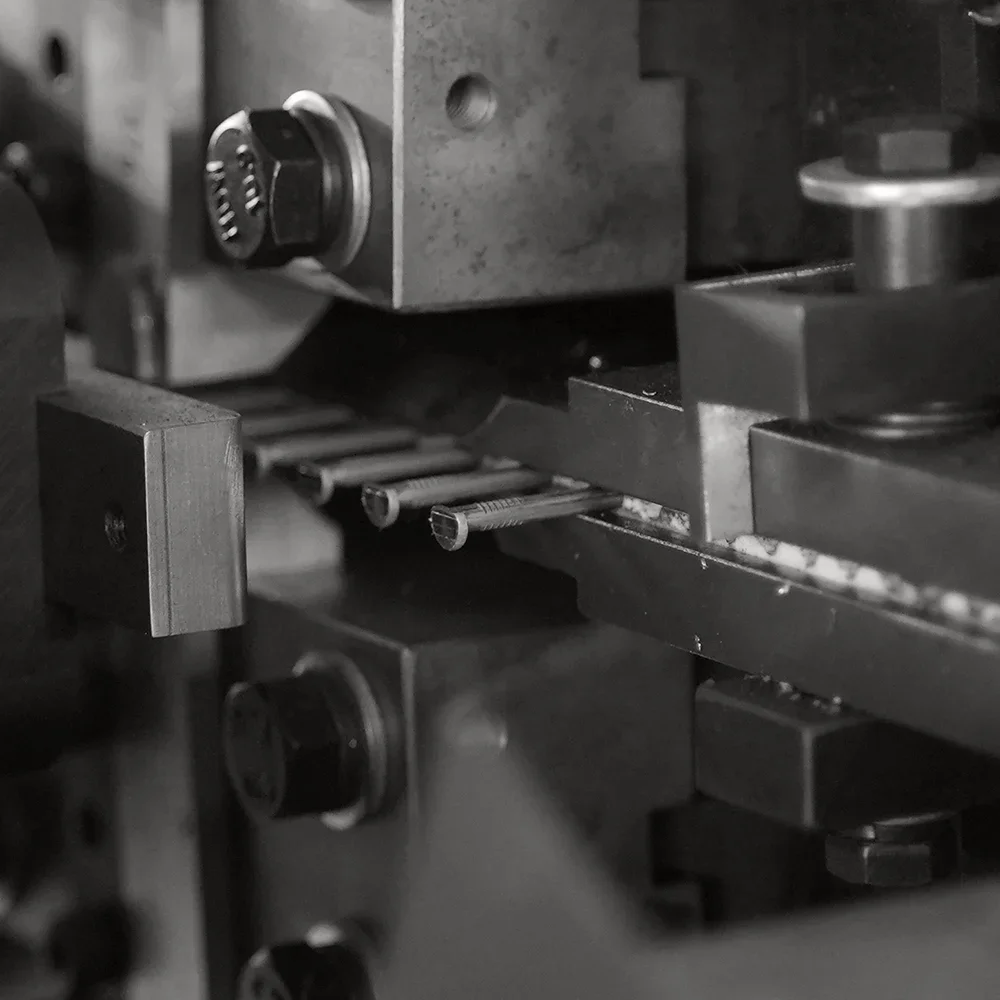
A nail plant, stage by stage
A nail plant turns low-carbon wire rod into finished nails in four tooling stages. The rod is descaled, drawn down to nail wire, formed into nails on a nail making machine, and — for ring-shank, screw-shank or coil nails — rolled and collated afterwards. Every stage runs on wear parts that only fit the machine they were made for.
Relink.Tools supplies the tooling for all four stages and matches it to your machine model. We do not sell nail making machines; we equip them.
What you get
- Gripper dies, cutters and punches matched from your machine model and nail size — you do not need to know the die dimensions.
- Drawing dies and drawing powder for the nail wire, as a full set when you give us the drawing machine.
- Thread rolling dies and collating wheels for ring-shank, screw-shank and coil nails, to drawing or to a sample.
- One enquiry covers all four stages.
- Wire rod
- Descaling
- Wire drawing
- Nail forming
- Thread rolling
- Collating
- Finished nails
What are you making?
Plain-shank nails in bulk
The shortest line: drawing dies for the wire, then gripper dies, cutters and punches on the nail making machine. Everything else below is optional. Tell us the machine model and the nail sizes you run.
Ring-shank and screw-shank nails
Plain nails from the same machine, then a planetary thread rolling machine adds the pattern. That adds one stage and one tool set — planetary thread rolling dies, ring pattern or screw pattern. Tell us the end use before the size.
Coil nails
Plain or patterned nails welded to two thin wires on a collating machine. That adds the collating wheel, made to order for the nail wire diameter, weld position and nail spacing.
What each stage needs
1. Descaling the rod
Before the rod can be drawn, the oxide scale has to come off. Mechanical descalers do this by bending the rod over a set of rolls so the scale cracks and falls away. Carbide descaling rolls are a long-life part on this stage and are replaced rarely.
Supplied as: carbide descaling rolls · Made to: descaler model · Ask for: rod diameter, descaler model. → Descaling rolls
2. Drawing the nail wire
Nail wire is drawn from rod to the finished wire diameter in several passes, usually dry. The dies are chosen by the rod size going in, the wire size coming out and the number of passes; if you give us the drawing machine model as well, we can propose the full set.
For nail wire we normally suggest nano-coated dies for the sizes you run every day and tungsten carbide dies for short runs and trials. A carbide die can be recut to the next size when it wears; a nano die cannot, but it runs far longer between changes. The drawing powder is matched to the wire and the die material.
Supplied as: nano-coated and carbide drawing dies, drawing powder · Made to: pass schedule or drawing machine model · Ask for: rod and finished wire diameters, number of passes, dry or wet. → Wire drawing dies · Wire drawing powder
3. Forming the nail: gripper dies, cutters and punches
On the nail making machine a pair of gripper dies holds the wire, a punch forms the head and a pair of cutters cuts the point. These three parts are made to the machine model and the nail diameter, and parts for one make of machine do not fit another even when they look alike.
Gripper dies come in two constructions: brazed, with a carbide face on a steel body, which is what high-speed machines use; and insert type, with replaceable carbide inserts — round dies take 4, 6 or 8 inserts to the machine drawing. Cutters are ground for four point styles: diamond, chisel, hatchet and blunt. Punches come with a plain or a checkered head face. Diamond wheels for regrinding the cutters are supplied with them.
Supplied as: gripper dies (brazed or insert type), cutters, punches, diamond regrinding wheels · Made to: machine model and nail diameter · Ask for: machine model, nail diameter and length, point style, head face. → Nail gripper dies, cutters and punches · Diamond wheels
4. Ring and screw shank: planetary thread rolling dies
Plain-shank nails become ring-shank or screw-shank nails on a planetary thread rolling machine. The tooling is a rolling ring and a fixed segment, in tool steel, made to drawing or to a sample. Ring pattern and screw pattern are two different dies for two different markets — ring shank for softwood, screw shank for hardwood — so tell us the use before the size.
Supplied as: rolling ring and fixed segment, ring or screw pattern · Made to: drawing or sample · Ask for: ring or screw pattern, nail diameter range, machine model. → Planetary thread rolling dies
5. Coil nails: collating wheels
Coil nails are loose nails welded to two thin wires so they can be fed from a coil nailer. On the collating machine the nails drop into grooves around a collating wheel: the groove pitch sets the nail spacing, the groove angle sets the weld angle, and the groove width matches the shank. One wheel covers one nail diameter range, and the grooves wear — worn grooves show up as uneven spacing, off-centre welds and jams. We make collating wheels to order.
Supplied as: collating wheels · Made to: order, per nail diameter range · Ask for: nail wire diameter, weld position, nail spacing. → Nail making tooling
What we supply for this line
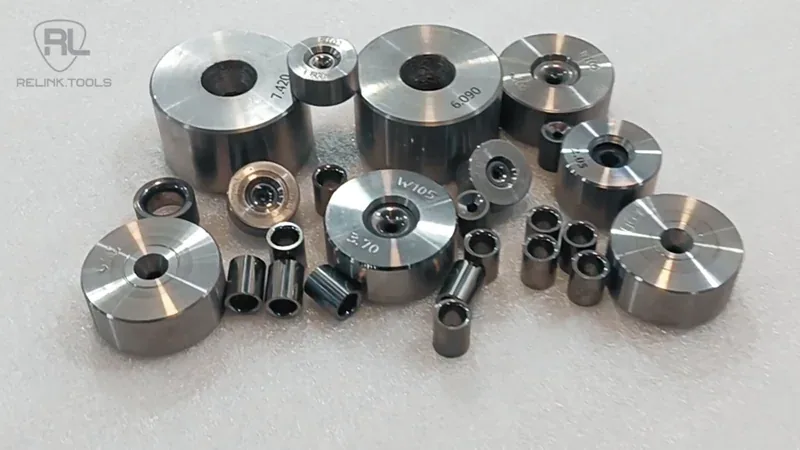 Wire drawing diesNano, carbide and PCD dies for rod-to-nail-wire drawing.
 Nail gripper dies, cutters and punchesBrazed or insert type, to the machine model and nail size.
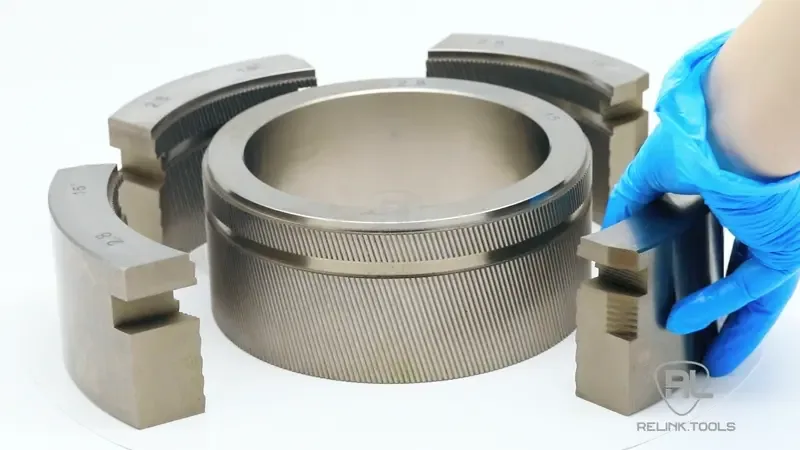 Planetary thread rolling diesRing and screw pattern, to drawing or sample.
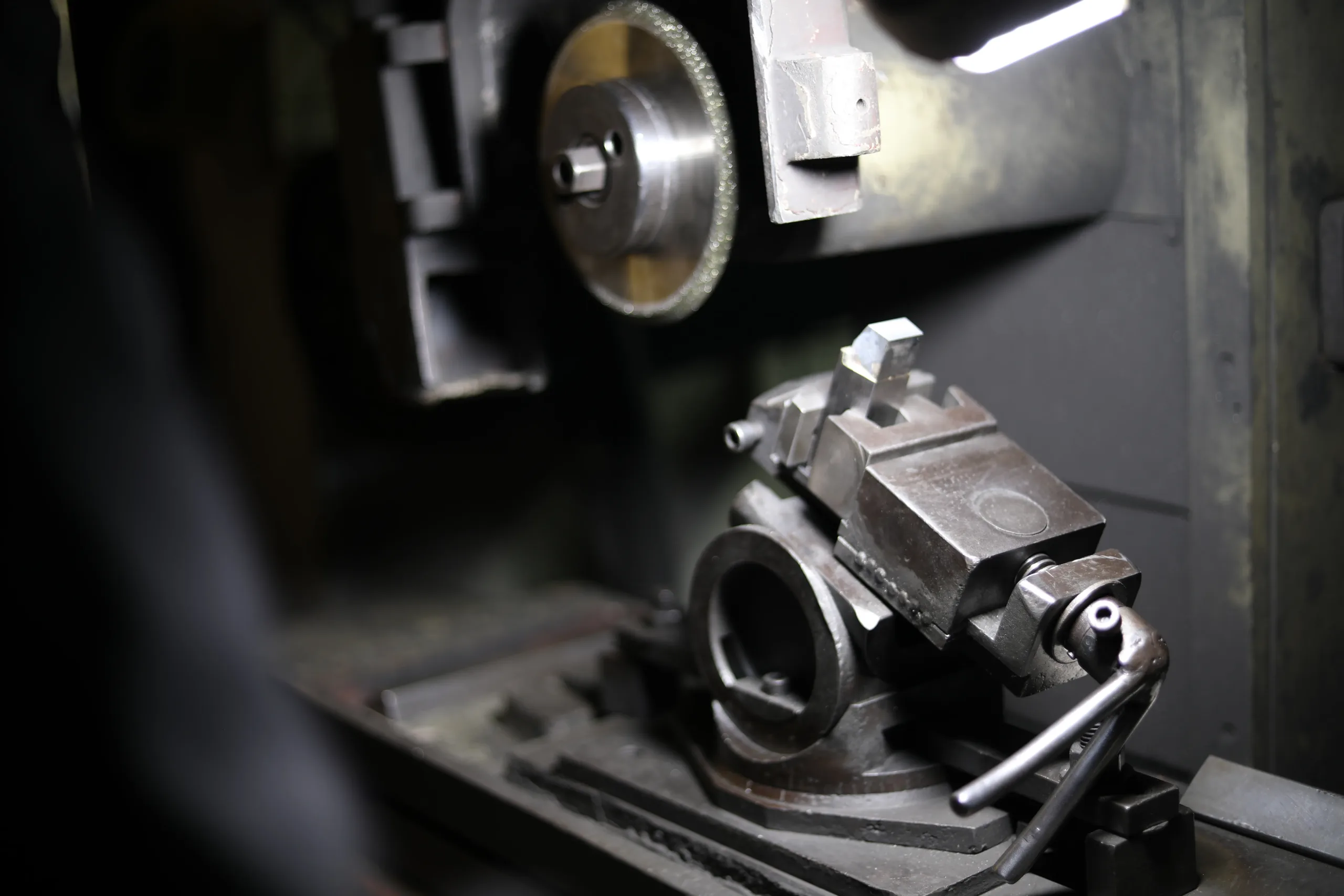 Collating wheelsMade to order for coil nail collating machines.
 Diamond wheelsFor regrinding nail cutters.
 Wire drawing powderDry drawing lubricant matched to the wire and die.
What we need to quote
Three things get a quote started: what you need, the machine model, and an email or WhatsApp number. The rest can follow in the technical details — the more of it you give, the faster the quote.
- Gripper dies, cutters, punches: machine model (Wafios N / S / DS, Kovopol THA, Tanisaka MTG, Vitari VR, Zeus, Moroni, Z94, X90 / X130B / X150B and others), nail diameter and length, point style, head face, brazed or insert type. Enkotec rotary machines use their own tooling — ask us separately.
- Drawing dies: rod and finished wire diameters, number of passes or drawing machine model, dry or wet, die material if you have a preference.
- Planetary thread rolling dies: ring or screw pattern, nail diameter range, machine model.
- Collating wheels: nail wire diameter, weld position, nail spacing.
- A photo of the worn part or a drawing, if you have one.
We publish the machine models we tool for; the die dimensions for each model we send with the quote.
Our suggestions
Give us the machine model, not the die size. Most buyers know their machine but not the die dimensions or the carbide grade behind it — and they should not have to. We keep model-to-die tables for the common machines and match from the model, the nail diameter and the nail length.
Start with nano for the running sizes, carbide for the rest. What matters is the die cost per tonne of wire, not the price of one die. A nano die costs more each but runs many times longer; a carbide die is the right choice for a short run, a trial size, or when you want a die you can recut later.
For ring and screw shank, say what the nails are for. The same rolling machine takes different dies for ring pattern and screw pattern, and the pattern follows the wood: ring shank holds in softwood, screw shank in hardwood. Tell us the end use and the diameter range, and we match the die.
Questions nail plants ask
I have just bought a nail making machine. What tooling do I need to start?
For plain nails you need the gripper dies, cutters and punches for your machine model and each nail size you will run, plus drawing dies and drawing powder for the wire. Add planetary thread rolling dies if you make ring- or screw-shank nails, and a collating wheel if you make coil nails. Send us the machine model and the nail sizes and we list the set.
Which nail making machines do you tool for?
Wafios, Kovopol, Tanisaka, Vitari, Zeus, Moroni and the Chinese Z94 and X-series machines, among others. Tooling is made to the model: dies for one make do not fit another even when the outline looks the same. Enkotec rotary forming machines use their own tooling system and are quoted separately.
What is the minimum order for gripper dies and punches?
Five pairs per size and model. Drawing dies and thread rolling dies have their own minimums — see the product pages or ask when you enquire.
Which carbide grade do you use for gripper dies?
The most common grade for nail gripper dies is a high-cobalt grade, YG20C, chosen for impact resistance rather than for the last bit of wear resistance. We match the grade to the machine and the nail size; you do not need to specify it.
Do you sell nail making machines?
No. We supply the tooling for them — drawing dies, gripper dies, cutters, punches, thread rolling dies and collating wheels — and match it to the machine you have or are buying.
Request a Quote
Get In Touch QuicklySend us your machine model or drawing, the wire or material, and the quantity. We will prepare a quotation.